The Changing Face of Real Estate: writeup of December’s BBP all-member event
22 January 2026The Changing Face of Real Estate: writeup of December’s BBP all-member event
22 January 2026In December 2025, the Better Buildings Partnership (BBP) brought together around 70 BBP and Managing Agents Partnership (MAP) members for our annual all member event, titled ‘The Changing Face of Real Estate’. The discussions provided fantastic insights into how the commercial real-estate market is evolving, and what this means for sustainability, ESG and investment decision-making. As we kick off 2026, these insights are directly shaping BBP’s programme of work – including continued opportunities for peer-to-peer exchange and the development of a series of short, sector-specific resources over the year ahead. This article first draws out some of the initial insights and reflections shared across different sectors at the event, before setting out how the BBP plans to take this learning forward.
Our December event, kindly hosted by BBP member Grosvenor, marked our final in-person gathering of the year and provided space to reflect on how structural, economic and societal shifts are reshaping real estate across both traditional and emerging sectors. We sought to provide members with deeper sector-specific insight, peer-to-peer exchange, and opportunity to inform the BBP’s future programme of work.
What members told us: insights from the sector roundtables
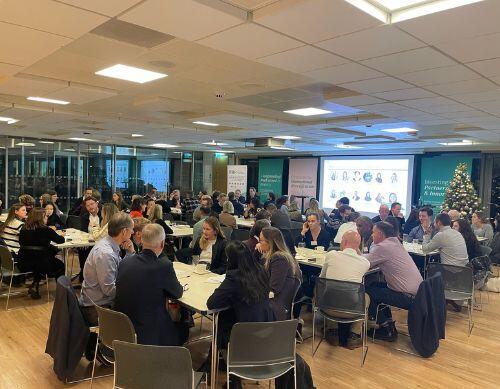
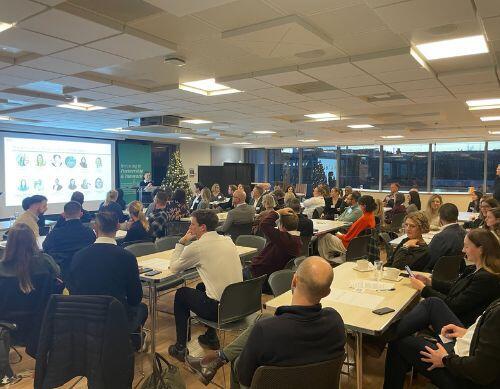
The heart of the event was a series of sector-specific breakout discussions, facilitated by members and supported by expert BBP moderators. These roundtables looked at traditional and more emerging sectors, including offices (traditional and flexible), retail (including shopping centres and high street), industrial and logistics, build-to-rent, life sciences and data centres, and were designed to surface practical insights from those working day-to-day in each sector.
Across sectors, members highlighted a growing gap between sustainability ambition and the levers available to deliver it. It was clear that the sectors we explored had highly distinctive challenges and opportunities.
- In flexible offices relationships with occupiers were often described as shorter-term and more transactional, making engagement, behaviour change and data sharing more challenging. Members noted particular difficulties around access to granular energy data, limited incentives for occupiers to reduce consumption where costs are bundled, and the need for buildings to become more responsive to fluctuating patterns of use.
- Discussions on data centres underlined how sustainability responsibilities are shaped by operating models. Owners are typically responsible for the shell and grid connection, while operators control fit-out and day-to-day efficiency, often under strict commercial confidentiality. While energy efficiency is already a commercial imperative for operators, members noted that this activity is not always visible within traditional real-estate ESG conversations. Power availability, grid capacity and engagement with distribution network operators were identified as critical factors shaping both growth and sustainability outcomes in the sector.
- In life sciences, members described a sector that remains attractive but highly specialised and sensitive to funding cycles. Occupiers’ requirements are often driven by speculative development pressures rather than sustainability performance alone, placing pressure on investors to maintain flexibility and future-proof labs by avoiding over-specification of assets. The importance of climate resilience, occupier wellbeing, and placemaking through community-building was repeatedly highlighted, alongside growing awareness of operational impacts such as energy intensity, water use and laboratory waste. Members noted a need for greater knowledge sharing on effective occupier engagement and existing good-practice guidance.
- In industrial and logistics, discussions focused on the tension between strong occupier demand and the practical challenges of delivering ESG outcomes at pace. Members highlighted constraints around power availability, land use, biodiversity requirements and transport emissions, alongside increasing expectations from occupiers for energy-efficient, resilient assets. Ensuring that sustainability considerations are embedded early — without slowing delivery — was seen as a key challenge.
- Retail discussions reflected continued divergence within the sector. Shopping centres and high streets were described as being in a phase of repositioning and adaptation, with a strong emphasis on social value, community engagement and mixed-use strategies including the growth of ‘experiential retail’. Members noted the opportunity to deliver sustainability benefits through refurbishment and reuse, while recognising the commercial and operational constraints facing older assets.
- Build-to-rent discussions highlighted the sector’s close alignment with social sustainability goals, alongside challenges around affordability, consistency of ESG implementation and translating design intent into operational performance at scale. Members noted that institutional ownership offers opportunities for stronger governance and data-led management, but that rapid growth brings its own complexities.
Across all tables, a consistent theme was the value of peer learning. Members emphasised how useful it was to compare approaches with others facing similar constraints, particularly in sectors where benchmarks, standards or established guidance are still evolving. As the BBP continues to deliver its vision to 2030, this will be central to our approach.
Setting the context: markets, megatrends and complexity
The afternoon opened with remarks from Janine Cole, Chair of the BBP Board, followed by a scene-setting presentation from Cameron Ramsey, Senior Director, Capital Markets, EMEA & UK Research & Strategy at JLL. Cameron provided an overview of current market liquidity, the growing share of operational and “living” sectors making up in investment flows, and his views on the distinction between long-term structural drivers and shorter-term cyclical trends.
A central message was that strong megatrends do not automatically translate into straightforward real-estate outcomes. While sectors such as life sciences, data centres and build-to-rent are supported by powerful demographic and technological tailwinds, the real-estate implications are often complex. Asset inflexibility, infrastructure and grid constraints, tenant concentration, funding cycles and political or regulatory risk can all influence whether sustainability ambition, investment performance and ESG outcomes align in practice.
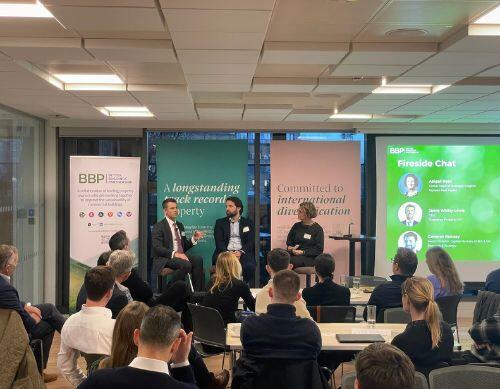
These themes were explored further in a fireside chat moderated by Abigail Dean, Global Head of Strategic Insights at Nuveen, with contributions from Jamie Whitty-Lewis, CEO of Grosvenor Property UK, alongside Cameron. The discussion reinforced that sustainability considerations are now inseparable from core investment, leasing and asset-management decisions, shaping where capital flows, how assets are designed and operated, and how risk is understood across portfolios.
What next for the BBP?
The discussions at the event reinforced that:
- Portfolios are diversifying.
- Sustainability challenges are increasingly shaped by sector-specific operating models, investment horizons and risk profiles.
There is no ‘one size fits all’ approach to sustainability across portfolios and implementation strategies are becoming increasingly nuanced. As part of the follow-up to this event, and in response to what members told us they would find most useful, the BBP will be publishing a series of short sector one-pagers over the course of 2026. Each will focus on one of the sectors explored during the event and will draw directly on member insight to set out:
- the key market changes being observed in that sector
- how these shifts are influencing investment and asset-management strategies
- and the implications for sustainability and ESG delivery in practice
These papers will provide a concise, shared reference point for BBP members and other commercial property owners navigating similar challenges, supporting more informed conversations within organisations and across portfolios. They will make use of the latest insights from our programme of work, and the BBP’s Real Estate Environmental Benchmark (REEB), which continues to gather quantitative data on member portfolios by asset type (currently covering office, retail & industrial assets, with plans to develop a commercial-residential category this year).
More broadly, the event underlined the importance of creating space for open, peer-to-peer exchange — particularly where sectors are evolving quickly and established guidance is still catching up. The insights shared will continue to inform how the BBP shapes its programme of work in 2026 and beyond, ensuring it remains grounded in the real-world experience of members and focused on delivering practical value.
We look forward to welcoming our members at BBP gatherings in 2026, with the following events scheduled and more to come:
12 February 2026 – Site visit: 11 & 12 Wellington Place
Hosted by Federated Hermes / MEPC, this visit will focus on one of the UK’s most advanced mixed-use business districts, highlighting low-carbon development, smart operations and social value delivery.
Contact: Jonathan Hulbert – j.hulbert@betterbuildingspartnership.co.uk
26 February 2026 – BBP–REVO Joint Event: Shopping Centres
A joint BBP–REVO session focused on sustainability and energy performance in large shopping centres, including insights from the BBP–REVO work on whole-building energy benchmarking and the implications for owners, operators and future regulation.
Contact: Rob MacWhannell – r.macwhannell@betterbuildingspartnership.co.uk
12 March 2026 – Urban Climate Walk
An in-person walking tour exploring how urban form of different building types influences climate, energy, wellbeing and resilience, led by Dr Julie Futcher.
Contact: Adam Baranowski – a.baranowski@betterbuildingspartnership.co.uk
18 March 2026 – Owner-Occupier Forum: Green leases
A dedicated session examining how green leases can support collaboration between owners and occupiers on energy performance, data sharing and operational outcomes.
Contact: Laura Noctor-King – l.noctor-king@betterbuildingspartnership.co.uk
Members are encouraged to get in touch with the BBP team to find out more about these events and how to get involved.