11 & 12 Wellington Place set new sustainability standard in the UK property sector
12 March 2026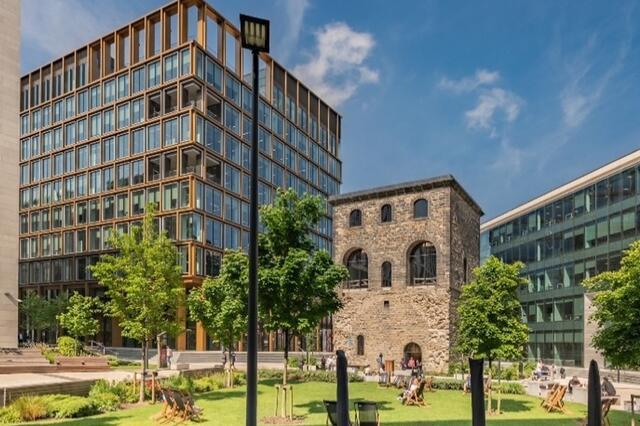
11 & 12 Wellington Place set new sustainability standard in the UK property sector
12 March 202611 & 12 Wellington Place have made history as the first buildings in the country to achieve a certified NABERS UK 5-Star Energy Rating, completing the Design for Performance journey. Developed by MEPC, the specialist real estate development platform within Federated Hermes, the buildings have also secured BREEAM Outstanding, EPC A and Fitwel 2-star ratings, placing them firmly among the most sustainable office developments in the UK. These impressive sustainability credentials have underpinned the buildings’ commercial success.
Key Facts
- All-electric buildings
- 100% renewable energy
- 41% more energy efficient than the average office building*
- All Cat A office space fully let within a year of completion
A Shared Commitment to Sustainability
The exceptional sustainability standards achieved at 11 & 12 Wellington Place in Leeds reflect the vision, dedication and collaboration of everyone involved, including investors, consultants, contractors, occupiers and property managers. With all parties committed to decarbonisation, there has been a sustained focus on net zero carbon and energy efficiency from initial design through to operational use, as well as social impact and wellbeing. MEPC also prioritised rigorous third-party certification to ensure credibility.
Since completion, the buildings have attracted leading organisations, including Arup, EY, ghd, Hill Dickinson, JLL and Lloyds Banking Group, underscoring strong market demand for high-performing, sustainable workspaces. The connected buildings provide 23,680m2 of office, leisure and retail space.
How do you create some of the UK’s most sustainable office buildings?
From the outset, the project team focused on a new way to measure the buildings’ sustainability performance using benchmarking tool NABERS UK. While EPCs improve understanding of a building’s theoretical energy performance and identify opportunities to improve efficiency, NABERS UK assesses a building’s actual energy consumption, against benchmarks developed using data from UK offices. Together, EPCs and NABERS give a fuller picture of energy performance. The independent design review central to the NABERS process also challenged design to improve energy performance, identifying risks and opportunities.
- Achieving operational net zero: A major shift in the energy strategy for 11 & 12 Wellington Place in 2020, due to the pandemic, led to the introduction of reversible air source heat pumps (ASHPs) to replace the proposed gas-fired boilers and air-cooled chillers, completely eliminating fossil fuel use and making the building all-electric. Fabric upgrades, glazing with improved U and G values, higher levels of air tightness, demand control ventilation and upgrades to lighting efficiency and controls also reduced energy demand. In addition, roof-mounted solar photovoltaics were increased from 500m² to 700m², allowing the buildings to run entirely on renewable energy through REGO-backed renewable tariffs complemented by on-site renewables. Together, these measures enabled the buildings to meet the UKGBC net zero carbon operational energy standard.
- Tackling whole life emissions: The project team reduced forecast embodied carbon by 38% across the project to 533kg CO2e/m2 at practical completion, from 866kg CO2e/m2 in the original design. Throughout construction, Wates used One Click LCA to track and report performance, and Cundall provided independent verification at completion. Low-carbon solutions include: a steel frame design offering large spans that reduce the number of concrete piles needed; lighter cellular beams that require shallower foundations; careful product specification, such as local supply chain and electric arc furnace steel; and offsite manufacturing.
- Enhancing wellbeing: The buildings are designed to improve occupiers’ wellbeing through high levels of natural daylight, views out to the River Aire and biophilic design, including living green walls lining the reception area, external roof terraces, inset balconies and landscaped surroundings. Facilities to promote active lifestyles and sustainable travel include 140 secure cycle spaces, 21 showers, changing facilities with drying rooms and lockers, and a cycle maintenance hub, along with free bike hire, bike buddy schemes and discounted public transport offers. A real-time energy management and metering system connects to a smart building platform, accessible via a mobile app. This supports the property team and occupiers in optimising spaces not only for efficiency but also for comfort and wellbeing.
- Adding economic and social value to central Leeds: From 2019 to 2022, over £44.5m of economic and social value was generated across Wellington Place, with 1,536 local construction jobs created and 269 apprenticeship weeks. More than 1,000 young people across Leeds have also benefited from Wellington Place’s long-term partnership with social enterprise Ahead Partnership, which aims to empower and equip young people with the skills, confidence and insight needed to thrive in the world of work.
Adding commercial, environmental and social value
Sustainability initiatives at 11 & 12 Wellington Place are delivering wide-ranging benefits:
- Commercial success: All Cat A office space fully let within a year of completion, with sustainability certifications NABERS UK 5-star, BREEAM Outstanding, EPC A and Fitwel 2-star providing rigour for claims, particularly when occupiers engage specialist teams to independently evaluate the available options.
- Climate action and decarbonisation: 7,885 tonnes of CO2 saved in construction (A1-A5) and 407 tonnes of CO2 saved annually through on-site PV, generating enough electricity to meet the equivalent annual demand of more than 42 homes.
- Operational savings: Reducing operational costs for occupiers, with 41% greater energy efficiency than the average building.
- Social impact: Local procurement, employment and education partnerships support business growth and societal benefit.
Future-proofing the portfolio
NABERS UK is part of MEPC’s efforts to deliver future-proofed, sustainable developments, constantly raising performance to achieve the latest standards. At 11 & 12 Wellington Place, MEPC, Arup and the property team are already exploring opportunities to reach 5.5 stars, with NABERS supporting continuous improvement through annual reviews. MEPC has also registered additional projects with NABERS UK across Birmingham, Leeds and Manchester.
“We’re incredibly proud to be the first new buildings in the UK to achieve a NABERS UK Energy Rating of Five Stars. We’re committed to continuing this momentum with future developments that set new standards for sustainability and performance.”
Miles Jones, Development Director at MEPC
Challenges and Achievements
CUSTOMERS
How do you secure legal agreements in the face of ‘unknown unknowns’?
As a pioneering project with no UK precedent, establishing an appropriate contractual framework presented legal challenges. MEPC drew on case studies and examples from Australia, where NABERS is well established, and worked closely with occupiers, who were highly supportive of the initiative. Together, they developed collaboration agreements that occupiers’ lawyers were comfortable to recommend for signature. Securing the support of occupier decision-makers was essential: their own sustainability commitments aligned with the ambitions of NABERS, creating a shared determination to drive the project forward.
IMPLEMENTATION
How do you bring everyone together to deliver on the ground?
There were three main challenges in delivery: coordinating everyone involved, avoiding any impact on programme and achieving the buildings’ design potential in operation. Collaboration and trust proved key at every stage. During development, there was more engagement between the design and construction teams than on standard projects, constantly updating modelling and testing impacts. The independent design review added an extra step to the programme, with orders for equipment only placed once the review had validated designs, making close working and timely information sharing across different organisations vital. During commissioning, MEPC and Wates engaged the property manager CBRE and maintenance contractor NG Bailey early on to understand systems from day one. In operation, NG Bailey holds weekly meetings with CBRE to interrogate energy data and monthly all-party meetings with MEPC, technical consultant Arup and property manager CBRE to identify opportunities to further optimise equipment and performance, including changing plant running hours and adjusting temperatures on central equipment.
*Arup analysis based on original design intent (2021).
*Please note that the information on this page was supplied by the BBP Member and the BBP assumes no responsibility or liability for any errors or omissions in the content